
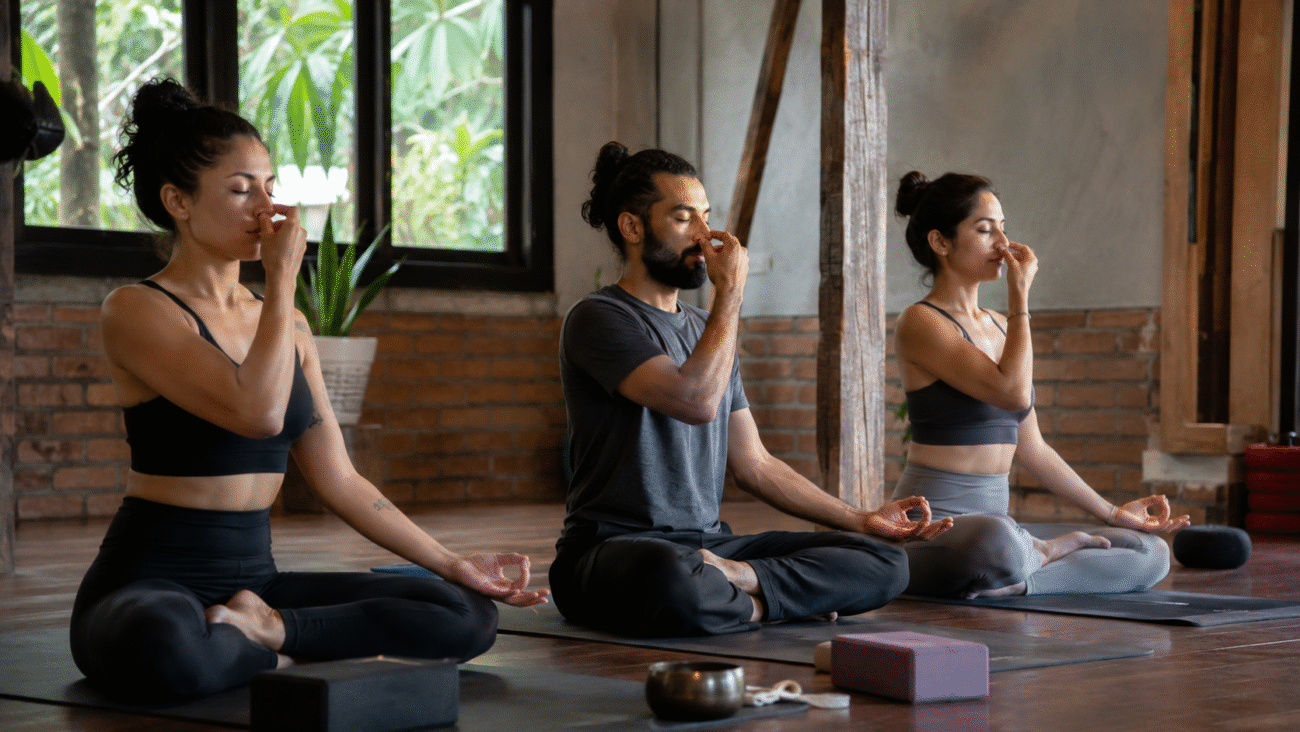
Bandha in pranayama refers to specific muscular locks used during breathing practices to control the movement of prana (life energy). The three main yoga locks are Mula Bandha (root lock), Uddiyana Bandha (abdominal lock), and Jalandhara Bandha (throat lock). Together, they improve breath control, stability, concentration, and energy flow during advanced pranayama practices.
What Is Bandha in Pranayama?
A bandha is a gentle muscular contraction used during yoga and pranayama.
The Sanskrit word “bandha” means “lock,” “bind,” or “seal.”
Instead of allowing energy to move randomly, yoga teaches that these locks help direct prana through the body’s energy channels (nadis). This improves focus and supports deeper meditation.
Think of bandhas like valves in a water pipe. They help control the direction and pressure of flow rather than stopping it completely.
The three primary yoga locks’ breathing techniques are
- Mula Bandha (Root Lock)
- Uddiyana Bandha (Abdominal Lock)
- Jalandhara Bandha (Throat Lock)
Advanced practitioners sometimes combine all three into Maha Bandha, or the Great Lock.
Why Bandhas Matter
Bandhas are not only physical muscle contractions.
They connect the body, breath, and mind.
Practicing bandhas during pranayama may help:
- Improve breath retention
- Increase body awareness
- Support proper posture
- Encourage mental focus
- Help manage energy during advanced breathing practices
Many traditional yoga schools consider bandhas an important part of progressing beyond basic breathing exercises.
How Bandhas Work
Bandhas are usually introduced after a student develops steady breathing.
Step 1: Establish a Comfortable Seat
Sit with a straight spine.
Relax your shoulders and breathe naturally.
Step 2: Practice Controlled Breathing
Begin with slow diaphragmatic breathing before adding any lock.
Step 3: Apply the Appropriate Bandha
Depending on the pranayama technique, gently engage the required muscles.
Never force the contraction.
Step 4: Maintain Awareness
Observe your breath and body without creating unnecessary tension.
The lock should feel stable but comfortable.
Step 5: Release Smoothly
Release the bandha slowly before returning to normal breathing.
Sudden release may disturb the rhythm of the breath.
The Three Main Bandhas
Mula Bandha (Root Lock)
Mula Bandha involves gently contracting the muscles of the pelvic floor.
It is often described as lifting the muscles at the base of the pelvis.
Purpose
- Creates stability
- Encourages upward movement of energy
- Improves concentration during meditation
Beginners should use only a gentle contraction rather than squeezing forcefully.
Uddiyana Bandha (Abdominal Lock)
Uddiyana means “to fly upward.”
This lock is usually practiced after exhaling completely.
The abdomen gently moves inward and upward beneath the rib cage.
Purpose
- Engages the deep abdominal muscles
- Improves awareness of the diaphragm
- Supports advanced breath control
Uddiyana Bandha should always be learned under qualified guidance.
Jalandhara Bandha (Throat Lock)
Jalandhara Bandha is created by lowering the chin toward the chest while lengthening the back of the neck.
It is commonly used during breath retention.
Purpose
- Supports safe breath retention
- Helps stabilize pressure during pranayama
- Encourages mental focus
Avoid forcing the neck into an uncomfortable position.
When Should You Practice Bandhas?
Bandhas are generally introduced after you become comfortable with:
- Natural breathing
- Diaphragmatic breathing
- Basic pranayama techniques
- Stable sitting posture
Many yoga teachers recommend learning them gradually rather than trying all three at once.
For students who wish to deepen their understanding of pranayama and traditional yogic practices, structured guidance through an advanced training program can help develop proper technique and safety. Explore the Advanced Pranayama Training here:
https://kundaliniyogashala.com/advanced-pranayama-training-online.php
Benefits of Bandha Pranayama
When practiced correctly, bandhas may offer several benefits.
Physical Benefits
- Better postural stability
- Improved breath awareness
- Greater core engagement
- Enhanced control during pranayama
Mental Benefits
- Increased concentration
- Better mindfulness
- Calmer breathing
- Improved meditation preparation
Energetic Benefits
Traditional yoga texts describe bandhas as helping the following:
- Guide prana through the central energy channel
- Balance internal energy
- Support advanced meditation practices
Scientific research on energetic effects remains limited, so these benefits are generally understood within traditional yogic philosophy.
Risks, Side Effects, or Limitations
Bandhas should always be practiced carefully.
Avoid advanced bandha practice if you have:
- Uncontrolled high blood pressure
- Serious heart conditions
- Pregnancy
- Recent abdominal surgery
- Hernia
- Severe neck injuries
Never force breath retention.
If you feel dizzy, uncomfortable, or short of breath, stop immediately and return to normal breathing.
Learning from an experienced yoga teacher greatly reduces the risk of incorrect practice.
Practical Example
Imagine you are practicing Nadi Shodhana (Alternate Nostril Breathing).
After several weeks of regular practice, your teacher introduces Jalandhara Bandha during gentle breath retention.
You lightly lower your chin toward your chest while maintaining a relaxed spine.
Instead of struggling, your breath feels more stable, your posture improves, and your attention becomes more focused.
This is how bandhas are typically added—slowly and progressively.
Tips for Beginners
If you’re new to bandha pranayama, keep these tips in mind:
- Learn one bandha at a time.
- Practice on an empty stomach.
- Keep breathing smoothly.
- Avoid excessive muscle tension.
- Never rush into advanced breath retention.
- Practice consistently rather than intensely.
- Seek guidance from a qualified yoga instructor.
Common Mistakes to Avoid
Many beginners make similar mistakes.
Avoid these common errors:
- Holding the breath too long
- Tightening the entire body
- Forcing the pelvic floor
- Collapsing the chest
- Straining the neck
- Skipping basic pranayama training
- Practicing without proper instruction
Remember, gentle control is more effective than force.
Expert Insights
Experienced yoga teachers often emphasize that bandhas develop naturally with consistent practice.
Rather than trying to “lock” the muscles as tightly as possible, the goal is subtle awareness and coordinated movement between breath, posture, and attention.
Students who build a strong foundation in basic pranayama generally find bandhas easier and more comfortable to learn later.
Patience is one of the most valuable skills in advanced yoga practice.
Frequently Asked Questions
1. What is bandha in pranayama?
Bandha is a gentle muscular lock used during pranayama to support breath control and guide the movement of prana according to traditional yoga teachings.
2. Which are the three main bandhas?
The three primary bandhas are Mula Bandha (root lock), Uddiyana Bandha (abdominal lock), and Jalandhara Bandha (throat lock).
3. Can beginners practice bandhas?
Yes, but beginners should first master basic breathing techniques. Bandhas should be learned gradually under qualified instruction.
4. Is Mula Bandha the same as squeezing the pelvic muscles?
Not exactly. Mula Bandha is a gentle lifting action rather than a strong squeeze. Proper technique becomes easier with guided practice.
5. When should Uddiyana Bandha be practiced?
Uddiyana Bandha is generally practiced after complete exhalation and on an empty stomach. It is considered an advanced practice.
6. Are bandhas scientifically proven?
Some physical benefits, such as improved posture and breath awareness, are supported by modern understanding of muscle engagement. Traditional energetic effects are based mainly on classical yoga philosophy.
7. Can bandhas improve meditation?
Many practitioners find that bandhas increase stability, concentration, and awareness, making meditation easier over time.
8. Who should avoid bandha practice?
People with pregnancy, uncontrolled hypertension, serious heart conditions, abdominal surgery, hernias, or significant neck injuries should consult a qualified healthcare professional and experienced yoga teacher before practicing.
Conclusion
Bandhas are an important part of advanced pranayama and traditional yoga. By learning Mula Bandha, Uddiyana Bandha, and Jalandhara Bandha, you develop greater awareness of your breath, posture, and internal stability.
Start slowly, focus on proper technique, and never force the practice. A strong foundation in basic pranayama will make learning bandhas safer and more rewarding.
As your confidence grows, guided instruction can help you integrate these powerful yoga locks into a deeper and more meaningful pranayama practice.
Continue Your Pranayama Journey
Building a strong foundation through pre-pranayama is the first step toward a safe and rewarding breathwork practice. Once you develop breath awareness, diaphragmatic control, and nervous system regulation, you can gradually progress through different levels of pranayama training.
Explore the next steps in your journey:
- Start with our 9-Day Foundation Breathwork & Pre-Pranayama Course
- Learn the fundamentals in our Beginner Pranayama Course
- Deepen your skills with the intermediate breathwork training.
- Master advanced techniques through our Advanced Pranayama Training
