
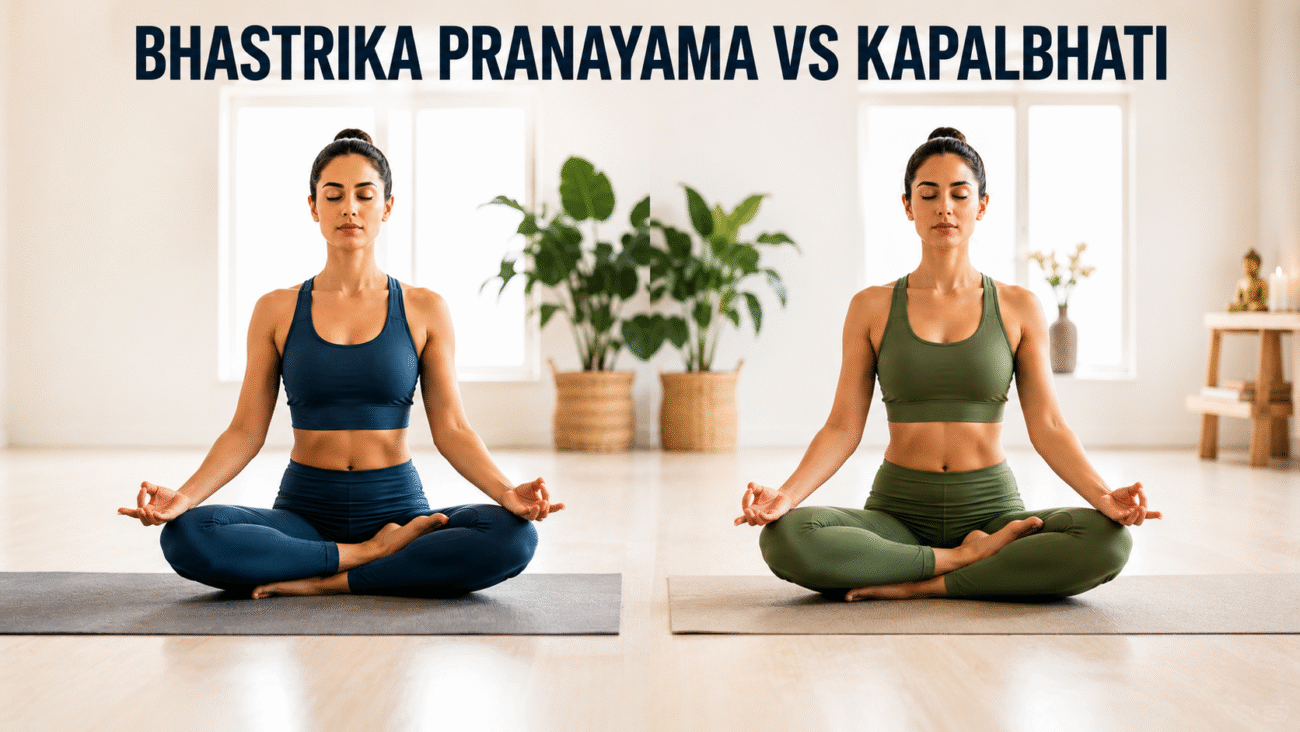
Bhastrika Pranayama and Kapalbhati are different breathing techniques. Bhastrika involves forceful inhalation and exhalation to increase energy and improve lung capacity, while Kapalbhati uses passive inhalation with forceful exhalation to cleanse the respiratory system and strengthen the abdominal muscles. Beginners should learn proper technique before practicing either method.
What is Bhastrika Pranayama?
Bhastrika pranayama is a traditional yogic breathing technique often called the “bellows breath.” In this practice, both inhalation and exhalation are active, deep, and forceful.
The movement is similar to a blacksmith’s bellows, which continuously pushes air in and out.
The goal is to:
- Increase oxygen intake
- Energize the body
- Improve lung capacity
- Prepare the mind for meditation
Unlike fast breathing exercises done casually, Bhastrika follows a controlled rhythm with proper posture and awareness.
What is Kapalbhati?
Kapalbhati is often classified as a cleansing technique (Shatkarma), although many yoga schools also teach it as a pranayama practice.
Its defining feature is
- Forceful exhalation
- Passive inhalation
Instead of actively breathing in, you quickly contract your abdominal muscles to push the air out. The inhale happens naturally.
This rhythmic action helps cleanse the respiratory passages while strengthening the core muscles.
Bhastrika vs Kapalbhati: Key Differences
| Feature | Bhastrika Pranayama | Kapalbhati |
|---|---|---|
| Inhalation | Active | Passive |
| Exhalation | Active | Forceful and active |
| Speed | Moderate to fast | Usually faster |
| Main Purpose | Energy and vitality | Cleansing and purification |
| Muscle Involvement | Chest and diaphragm | Abdominal muscles |
| Difficulty | Moderate | Beginner to intermediate with guidance |
| Primary Focus | Breath expansion | Breath cleansing |
Why It Matters
Understanding the difference helps you choose the right practice for your goals.
If your goal is to:
- Boost energy before yoga → Bhastrika is often preferred.
- Cleanse the respiratory system → Kapalbhati may be more suitable.
- Improve breathing awareness → Either can help when practiced correctly.
- Build a strong pranayama foundation → Learn both gradually under qualified instruction.
Practicing the wrong technique or using poor form can lead to dizziness, fatigue, or unnecessary strain.
How It Works
Step 1: Sit Comfortably
Choose a stable seated posture with a straight spine.
Relax your shoulders and face.
Step 2: Focus on Your Breath
Take a few slow, natural breaths before beginning.
This helps prepare your lungs and nervous system.
Step 3: Practice the Technique
For Bhastrika:
- Forcefully inhale.
- Forcefully exhale.
- Maintain an even rhythm.
For Kapalbhati:
- Forcefully exhale by pulling the abdomen inward.
- Allow the inhale to happen naturally.
- Repeat smoothly without tension.
Step 4: Rest
Pause after each round.
Notice your breathing and heartbeat.
Step 5: End with Calm Breathing
Finish with slow breathing or quiet meditation.
This allows the body to absorb the effects of the practice.
Benefits of Bhastrika Pranayama
Regular practice may help:
- Improve lung capacity
- Increase oxygen supply
- Boost energy levels
- Improve breathing efficiency
- Support mental alertness
- Prepare the body for meditation
- Improve breath awareness
- Warm the body during yoga practice
Many practitioners enjoy Bhastrika in the morning because it creates a feeling of freshness and vitality.
Kapalbhati Benefits
Some commonly reported Kapalabhati benefits include:
- Helps clear nasal passages
- Strengthens abdominal muscles
- Improves breathing control
- Supports respiratory health
- May improve concentration
- Helps develop diaphragmatic awareness
- Can create a feeling of mental clarity
While many people also associate Kapalbhati with weight loss or detoxification, current scientific evidence is limited. It should not be viewed as a replacement for exercise, medical treatment, or a balanced diet.
Risks, Side Effects, or Limitations
These breathing techniques are not suitable for everyone.
Avoid or seek professional guidance if you have the following:
- High blood pressure
- Heart disease
- Pregnancy
- Recent surgery
- Epilepsy
- Severe asthma
- Glaucoma
- Chronic dizziness
Stop immediately if you experience:
- Chest pain
- Severe dizziness
- Blurred vision
- Shortness of breath
Learning from a qualified yoga teacher greatly reduces the risk of incorrect practice.
Practical Example
Imagine two students.
Sarah feels tired before her morning yoga session.
Her teacher recommends a few rounds of Bhastrika to energize her body before meditation.
David often experiences nasal congestion.
His instructor teaches Kapalbhati to help improve breath awareness and gently support respiratory cleansing.
Although both are breathing exercises, their goals are different.
Tips for Beginners
If you’re new to pranayama:
- Learn one technique at a time.
- Practice on an empty stomach.
- Sit comfortably with a straight spine.
- Start slowly.
- Focus on technique instead of speed.
- Stop if you feel uncomfortable.
- Practice under a trained instructor whenever possible.
If you want to deepen your understanding of pranayama and traditional yogic breathing, consider joining a structured advanced & intermediate pranayama training offered by Kundalini Yogashala:
https://kundaliniyogashala.com/advanced-pranayama-training-online.php
Common Mistakes to Avoid
Many beginners make simple mistakes.
Avoid:
- Moving too fast
- Holding unnecessary tension
- Raising the shoulders excessively
- Forcing the breath
- Practicing immediately after eating
- Ignoring dizziness
- Comparing your speed with others
have the following: Correct technique is always more important than intensity.
Expert Insights
Experienced yoga teachers often emphasize that breathing practices should be built gradually.
A common progression is:
- Learn natural diaphragmatic breathing.
- Practice simple pranayama.
- Develop steady breath control.
- Introduce Kapalbhati.
- Progress to Bhastrika with proper guidance.
- Eventually combine advanced pranayama techniques as part of a complete yoga practice.
Consistency usually brings better results than practicing intensely for a short period.
Frequently Asked Questions
1. Is Bhastrika better than Kapalbhati?
Neither is universally better. Bhastrika focuses more on energizing the body through active inhalation and exhalation, while Kapalbhati emphasizes forceful exhalation for cleansing. The better choice depends on your goals and experience.
2. Can beginners practice Kapalbhati?
Yes, beginners can learn Kapalbhati with proper instruction. Starting slowly and focusing on technique helps reduce the risk of strain or dizziness.
3. Can I practice Bhastrika every day?
Many healthy people practice bhastrika daily in moderation. However, individuals with certain medical conditions should consult a healthcare professional or qualified yoga instructor first.
4. Which burns more calories?
Neither practice should be considered a calorie-burning exercise. Their primary purpose is breath control and yogic practice rather than weight loss.
5. Should I do Kapalbhati before Bhastrika?
The sequence depends on the yoga tradition and teacher. Many structured pranayama sessions follow a planned order based on the practitioner’s level.
6. Can these breathing exercises cure diseases?
No. While they may support overall wellness and respiratory function, they are not cures for medical conditions and should not replace professional healthcare.
7. What is the best time to practice?
Early morning on an empty stomach is generally considered the ideal time. A quiet environment allows better focus and breathing control.
8. How many rounds should beginners do?
Most beginners start with a small number of comfortable rounds under supervision. Quality of breathing is more important than quantity.
Conclusion
Understanding Bhastrika vs. Kapalbhati helps you choose the breathing practice that best fits your needs.
Bhastrika Pranayama focuses on powerful inhalation and exhalation to increase energy and improve breathing capacity. Kapalbhati emphasizes forceful exhalation to support cleansing and strengthen the abdominal muscles.
Both techniques have valuable benefits when practiced correctly, but neither should be rushed. Learn the fundamentals, progress gradually, and seek guidance from a qualified instructor whenever possible.
If you’re ready to advance your pranayama practice, explore the Advanced & Intermediate Pranayama Training from Kundalini Yogashala to build a deeper understanding of traditional breathing techniques.
Continue Your Pranayama Journey
Building a strong foundation through pre-pranayama is the first step toward a safe and rewarding breathwork practice. Once you develop breath awareness, diaphragmatic control, and nervous system regulation, you can gradually progress through different levels of pranayama training.
Explore the next steps in your journey:
- Start with our 9-Day Foundation Breathwork & Pre-Pranayama Course
- Learn the fundamentals in our Beginner Pranayama Course
- Deepen your skills with the intermediate breathwork training.
- Master advanced techniques through our Advanced Pranayama Training
