
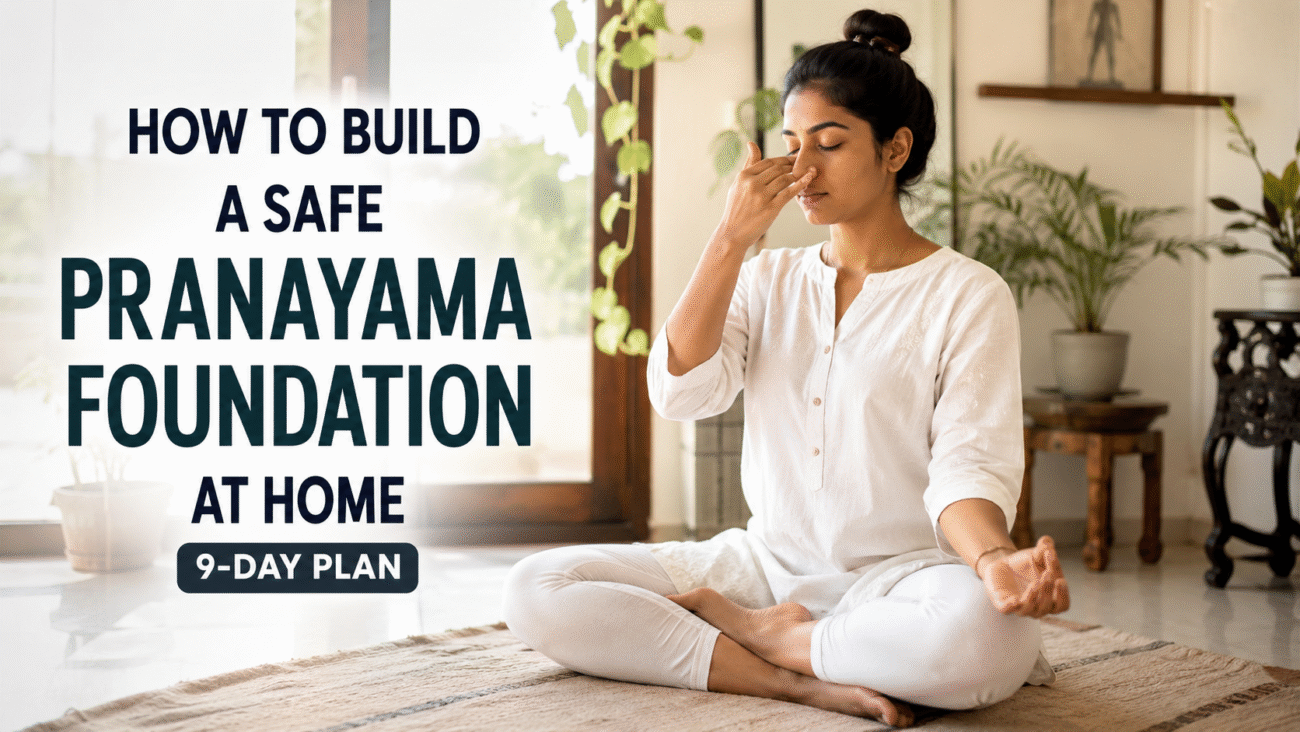
Safe Pranayama Foundation at Home is the best approach for beginners who want to learn pranayama safely and confidently. By building a Safe Pranayama Foundation at home first, you can improve breathing awareness, avoid common mistakes, and create a daily practice that supports long-term health and relaxation.
What Is Pranayama?
Pranayama is the yogic practice of controlling and regulating the breath.
The word comes from Sanskrit:
- Prana = life force or vital energy
- Ayama = expansion or control
In simple terms, pranayama teaches you how to breathe consciously rather than automatically.
Breath is closely connected to physical health, mental clarity, emotional balance, and relaxation.
Why It Matters
Most people breathe shallowly without realizing it.
Poor breathing habits may contribute to:
- Stress
- Anxiety
- Mental fatigue
- Poor focus
- Low energy
- Muscle tension
Learning proper breathing techniques helps create a calmer nervous system and improves awareness of your body and mind.
A strong foundation also reduces the risk of discomfort when learning advanced pranayama later.
How Pranayama Works
Pranayama works by influencing the autonomic nervous system.
When breathing becomes slow and controlled:
- Heart rate may decrease
- Stress response may reduce
- Oxygen delivery becomes more efficient
- Mental focus often improves
- Relaxation increases
The goal is not to hold the breath for long periods. The goal is to create smooth, comfortable, and mindful breathing patterns.
The 9-Day Safe Pranayama Foundation Plan
Step 1: Day 1 – Establish Good Posture
Spend 5 minutes sitting comfortably.
Focus on:
- Straight spine
- Relaxed shoulders
- Soft jaw
- Natural breathing
Do not change your breathing yet.
Simply observe it.
Step 2: Day 2 – Breath Awareness
Practice for 5–7 minutes.
Notice:
- Length of inhale
- Length of exhale
- Chest movement
- Belly movement
Avoid controlling the breath.
Become aware of your natural breathing pattern.
Step 3: Day 3 – Diaphragmatic Breathing
Place one hand on your belly.
As you inhale:
- Belly gently expands
As you exhale:
- Belly softly contracts
Practice for 5 minutes.
This helps train deeper, healthier breathing.
Step 4: Day 4 – Slow Breathing
Begin slowing your breath slightly.
Try:
- Inhale for 4 counts
- Exhale for 4 counts
Keep breathing smoothly and comfortably.
Never strain.
Step 5: Day 5 – Extended Exhale
Practice:
- Inhale for 4 counts
- Exhale for 6 counts
Longer exhalations often help activate relaxation responses in the body.
Practice for 5–8 minutes.
Step 6: Day 6 – Equal Breathing
Also known as Sama Vritti.
Try:
- Inhale for 4 counts
- Exhale for 4 counts
After comfort develops:
- Inhale for 5 counts
- Exhale for 5 counts
Maintain a relaxed rhythm.
Step 7: Day 7 – Ujjayi Awareness
Practice a very gentle version of Ujjayi breathing.
Create a soft whisper-like sound in the throat.
Keep your breath:
- Smooth
- Quiet
- Comfortable
Practice for 3–5 minutes.
Step 8: Day 8 – Introduction to Alternate Nostril Breathing
Practice simple Nadi Shodhana without breath retention.
Steps:
- Close right nostril
- Inhale through left
- Close left nostril
- Exhale through right
- Inhale through right
- Exhale through left
Continue for several rounds.
Step 9: Day 9 – Combine the Foundation
Create a short routine:
- 2 minutes posture awareness
- 3 minutes diaphragmatic breathing
- 3 minutes equal breathing
- 3 minutes alternate nostril breathing
This becomes your foundational practice moving forward.
Timeline and Duration
The 9-day plan is designed for gradual adaptation.
Daily commitment:
- 5–15 minutes
- Quiet environment
- Consistent timing
Many beginners notice improved awareness within the first week.
Long-term benefits develop with regular practice over months.
Types of Beginner-Friendly Pranayama
These techniques are generally suitable for beginners:
| Technique | Purpose |
|---|---|
| Breath Awareness | Builds mindfulness |
| Diaphragmatic Breathing | Improves breathing efficiency |
| Sama Vritti | Creates balance |
| Nadi Shodhana | Encourages calmness |
| Gentle Ujjayi | Enhances focus |
Avoid advanced breath retention practices until guided by a qualified instructor.
Benefits of Building a Strong Foundation
A safe pranayama foundation can help:
- Improve breathing awareness
- Support relaxation
- Increase focus
- Enhance meditation practice
- Reduce stress levels
- Encourage emotional balance
- Develop healthier breathing habits
- Prepare for advanced pranayama
Consistency matters more than intensity.
Risks, Side Effects, or Limitations
Pranayama is generally safe when practiced gently.
However, problems can occur when:
- Breathing is forced
- Breath holds are excessive
- Advanced techniques are attempted too early
- Practice is done during illness
Possible symptoms include:
- Dizziness
- Lightheadedness
- Headache
- Anxiety
Stop immediately if discomfort occurs.
People with medical conditions should consult a healthcare professional before starting.
Tips for Beginners
- Practice on an empty or light stomach
- Choose a quiet space
- Sit comfortably
- Keep shoulders relaxed
- Never force the breath
- Stop if you feel dizzy
- Focus on consistency
- Start with short sessions
Small daily practice beats occasional long sessions.
Common Mistakes to Avoid
Many beginners make these errors:
Trying Advanced Techniques Too Early
Master basic breathing first.
Forcing Deep Breaths
Breathing should feel natural, not aggressive.
Practicing Irregularly
Consistency creates progress.
Poor Posture
A collapsed posture restricts breathing.
Holding the Breath Excessively
Breath retention should be learned gradually.
Expert Insights
Experienced yoga teachers often emphasize one principle:
Build awareness before control.
Many students want advanced pranayama techniques immediately. Yet the greatest improvements often come from mastering simple breathing habits first.
A slow, steady approach is usually safer and more sustainable than rushing through techniques.
Quality of breath matters more than complexity.
For deeper study, organizations such as the Yoga Alliance provide educational resources on yoga and breathing practices.
Frequently Asked Questions
1. Can I learn pranayama at home?
Yes. Beginners can safely learn basic pranayama at home when starting with simple techniques and avoiding advanced breath retention practices.
2. How long should I practice each day?
Most beginners can start with 5–15 minutes daily. Consistency is more important than practicing for long periods.
3. Is pranayama safe for everyone?
Pranayama is generally safe when practiced gently. People with respiratory, cardiovascular, or medical conditions should seek professional guidance first.
4. When is the best time to practice pranayama?
Morning is often preferred because the mind is fresh and distractions are minimal. However, any consistent time can work.
5. Can pranayama reduce stress?
Many people find pranayama helpful for relaxation because slow breathing may support nervous system regulation and mental calmness.
6. Should I hold my breath as a beginner?
Usually no. Beginners should focus on smooth breathing before learning breath retention techniques.
7. What if I feel dizzy during practice?
Stop immediately and return to normal breathing. Dizziness often indicates overexertion or excessive breath control.
8. How long does it take to see results?
Some people notice increased relaxation within days. Long-term benefits typically develop through consistent practice over weeks and months.
9. Can pranayama improve meditation?
Yes. Controlled breathing often helps quiet the mind, making meditation easier and more comfortable.
Conclusion
Building a safe pranayama foundation at home does not require complicated techniques or long practice sessions.
Start with posture, awareness, and simple breathing exercises. Follow the 9-day plan step by step, stay consistent, and avoid rushing into advanced methods.
The strongest pranayama practice is built on patience, comfort, and steady progress. Begin with a few minutes each day and allow your breathing skills to grow naturally over time.
Continue Your Pranayama Journey
Building a strong foundation through pre-pranayama is the first step toward a safe and rewarding breathwork practice. Once you develop breath awareness, diaphragmatic control, and nervous system regulation, you can gradually progress through different levels of pranayama training.
Explore the next steps in your journey:
- Start with our 9-Day Foundation Breathwork & Pre-Pranayama Course
- Learn the fundamentals in our Beginner Pranayama Course
- Deepen your skills with the intermediate breathwork training.
- Master advanced techniques through our Advanced Pranayama Training
Each program is designed to help you progress step-by-step while maintaining safety, awareness, and authentic yogic principles.
